
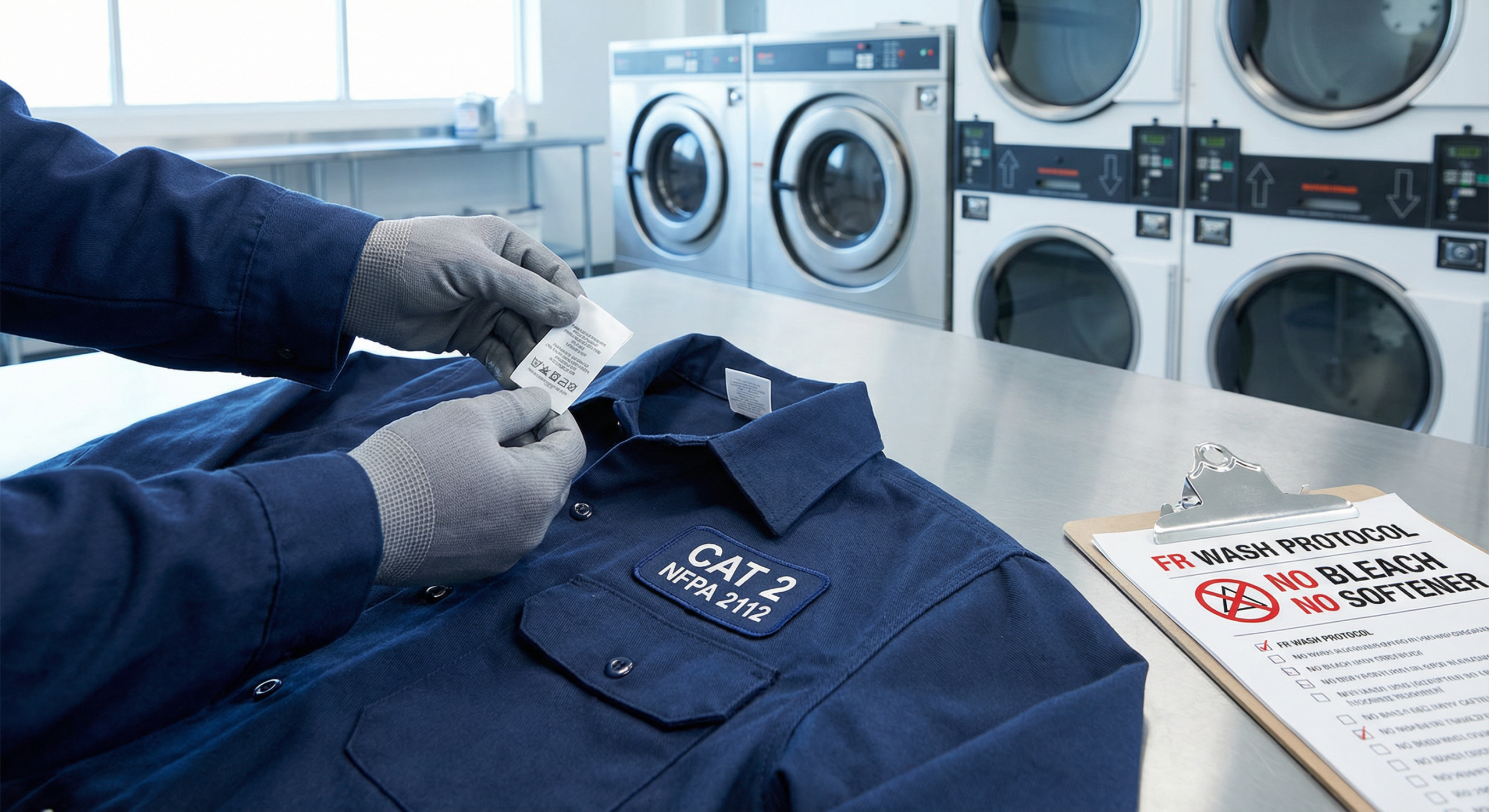
FR (flame-resistant) and arc-rated garments are designed for specific hazards—but care and contamination control are what keep them reliable over time. Use this guide as a safe baseline, then match it to your garment’s care label and workplace rules.
Quick Links
- /fabric-softener-on-fr-clothing/
- /wash-hi-vis-clothing-reflective-tape/
- /ppe-decontamination-retirement-guide/
Quick safety rules (save this)
- Read the care label first.
- As a safe default: avoid chlorine bleach, fabric softeners, and starch unless the care label explicitly allows them.
- Wash contaminated FR gear separately.
- If clothing is contaminated with hazardous/caustic materials, treat it as remove-from-service until proven safe.
1) FR vs “inherent FR” (why it matters)
There are two common categories:
- Inherent FR fibers (example: Nomex): the flame resistance is built into the fiber chemistry and is not meant to be “washed out.”
- FR-treated fabrics (common in workwear): protection depends more heavily on correct care and avoiding damaging wash chemistry.
Either way, contamination (fuel/grease/solvents) + wrong laundering chemicals are major threats to garment performance and service life.
2) Real-world label example (Carhartt FR)
Many brands provide specific “do not use” lists and temperature caps.
For example, Carhartt’s FR care instructions (when the care label is missing) include:
- Unlined FR: machine wash warm not to exceed 160°F (70°C); do not use chlorine bleach, hydrogen peroxide bleach, softeners, or starch; tumble dry low; iron low; dry cleanable.
- Lined FR: machine wash warm not to exceed 140°F (60°C); same “do not use” list.
Your brand may differ—use this as a pattern: temperature limit + avoid certain additives.
3) Best-practice home washing checklist (safe baseline)
Before washing
- Turn garments inside out.
- Remove debris from pockets (metal shavings, oily rags, etc.).
- Wash FR items separately (especially if there’s heavy soil/contamination).
Machine settings
- Normal cycle (or as label recommends)
- Warm water (stay under label max)
- Consider extra rinse to reduce residue
Detergent
- Use a normal consumer laundry detergent unless your employer specifies otherwise.
- Avoid harsh, highly alkaline stain treatments unless you know they are compatible with your FR garment.
4) Drying rules
- Low heat is the safest default.
- Avoid over-drying (excess heat/time can stress fabrics).
- If your workwear includes reflective trim, check trim guidance and label instructions—some user guides warn that dryers can damage reflective trim.
5) Nomex note (common in fire/aviation PPE)
Nomex care guidance for wildland PPE commonly warns against strong oxidizing agents (peroxides/bleaches) and notes that over-drying can damage fabric strength—so keep your routine conservative.
6) Clean vs decontaminate vs retire (critical safety decision)
Not every problem is a “stain.”
If garments are contaminated by hazardous/caustic materials (solvents, fumes, mists, vapors, etc.), some NFPA 2112 user guidance states they must be immediately removed from service and retired unless a qualified authority can demonstrate they are properly decontaminated and safe for reuse.
FAQ
Can I use fabric softener on FR clothing?
As a safe default: No. Many FR care labels explicitly prohibit it, and some NFPA 2112 user guidance warns softeners are oil-based and can contribute to flammability.
Can FR clothing be dry-cleaned?
Some brands allow it, but some NFPA 2112 user guidance warns “do not dry clean” because solvents may damage garments. Always follow the label and your safety program.
What temperature should I wash FR workwear?
Follow your label. As an example, Carhartt specifies up to 160°F (70°C) for many unlined FR items and up to 140°F (60°C) for lined FR.
Sources (for references):