How to Remove Salt Stains from Car Carpet (So They Don’t Come Back)
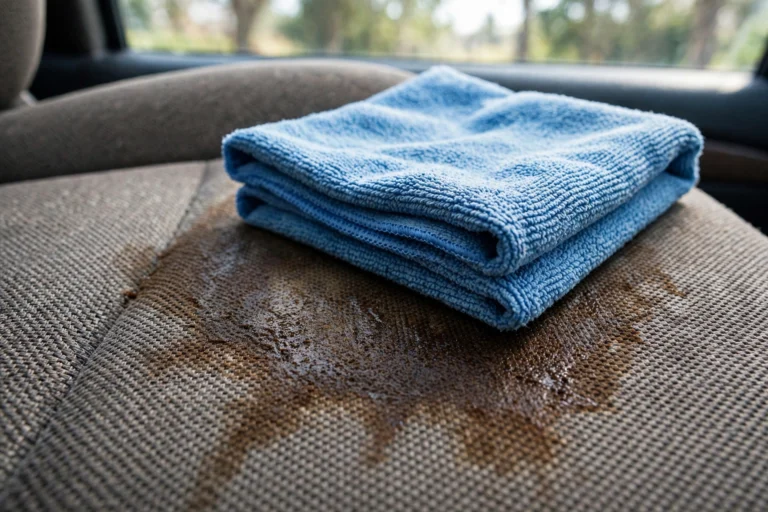
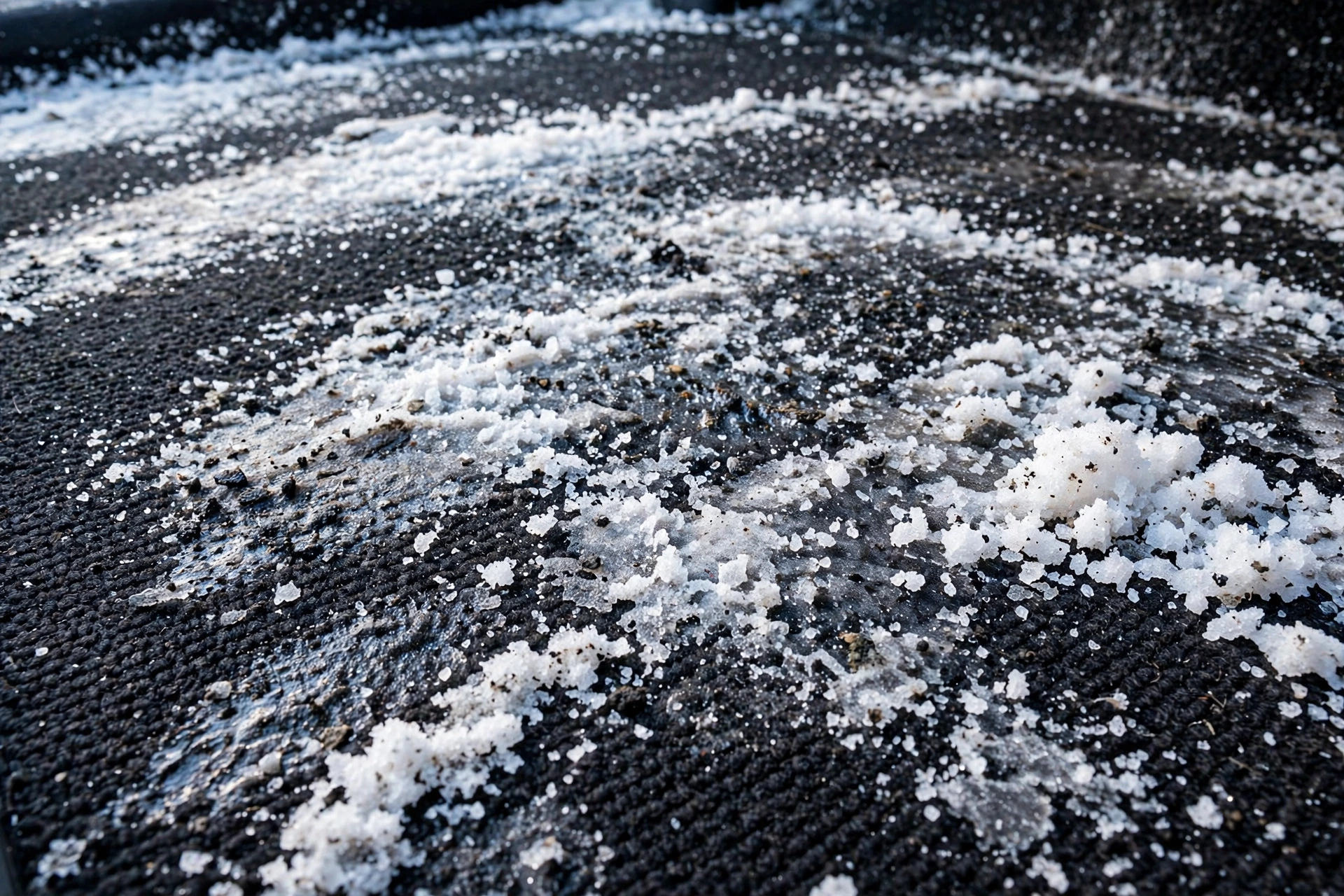
Every winter the same white crust appears on the driver’s footwell — and every winter you clean it, only to find it back the next morning. Learning how to remove salt stains from car carpet properly starts with why that crust returns: the fix is not stronger scrubbing, but dissolving the salt and getting the salty water out before it dries.
Quick Answer
Vacuum the dry salt off first, then mist a 50/50 mix of white vinegar and warm water onto the stain, let it sit for 5 minutes, brush gently, and blot or vacuum the moisture back out. The stain returns because salt in the padding wicks up as it dries — so extraction, not scrubbing, is the fix. Never soak the carpet.
Why Do Salt Stains Keep Coming Back After You Clean Them?
Because the salt is not only on the surface. Melted snow carries dissolved road salt deep into the carpet and the foam padding underneath. When you clean only the top, the water evaporates and the salt left below travels back up through the fibers by capillary action — called wicking — and recrystallizes as a white crust at the edge of the damp area.
That is the cycle: dry crystals sit on the fibers, liquid dissolves them into brine, and evaporation leaves the salt where it dries fastest — at the edges. Scrubbing cannot fix it, because scrubbing only works the surface while the salt lives below it.
What Do You Need to Remove Salt Stains from Car Carpet?
You need very little, and no special salt-removal product. A vacuum with a crevice tool, a spray bottle, distilled white vinegar, warm to hot water (not boiling), a stiff-bristle brush, several clean microfiber towels — and, if you have one, a wet/dry vacuum or extractor.
How Do You Remove Salt Stains from Car Carpet?
Work in small sections, about 6 to 12 inches wide, so you can extract each area before liquid reaches the backing.
Step 1 — Vacuum dry first. Take removable mats out first — cleaning them inside the footwell lets salty runoff reach the floor carpet, padding and seat rails. Shake each mat outdoors, then vacuum the carpet and both sides of the mats, crevice tool along seams and edges. Never start with liquid; wetting dry salt turns it into mud.
Step 2 — Mix the solution. Combine equal parts white vinegar and warm to hot water — a 50/50 blend. Family Handyman’s method uses 50-percent vinegar and 50-percent hot water. Vinegar is a mild acetic acid that reacts with the alkaline mineral salts in the crust — sodium chloride, calcium carbonate and magnesium carbonate, per Family Handyman.
Step 3 — Spot-test, then mist. Spray one hidden corner first, under a seat, and check for colour change after a minute. Then lightly spray the stain until the fibers are damp, not wet through to the padding, and let it sit for 5 minutes. Brush gently in one direction — not circles.
Step 4 — Extract. This is the most important step. Press a clean, dry microfiber towel firmly onto the area — blot, don’t rub — until no more moisture transfers, folding to a clean section and repeating. A wet/dry vacuum pulls far more salt-laden water out than blotting alone.
Dry the carpet completely: leave the doors open, or set a small fan nearby for 2–4 hours. A damp carpet closed up overnight grows mildew. If the stain survives one pass, repeat steps 3–4 once — two passes is the limit.
Rubber mats are different: salt cannot soak into rubber, so pull them out, shake off the grit, wash with warm soapy water, scrub the grooves, rinse until the surface no longer feels slick, and air-dry — about 10 minutes per mat.
Method Comparison: What Actually Removes Salt?
| Method | How it works | Best for | Watch out |
|---|---|---|---|
| Plain warm water | Dissolves sodium chloride on contact | Fresh, light stains | Won’t cut mineral film; extraction still required |
| Vinegar 50/50 + warm water | Acetic acid breaks down alkaline mineral deposits | Most winter stains, the standard DIY fix | Spot-test first; vinegar smell fades as it dries |
| Foaming carpet cleaner | Surfactants lift grime holding salt to fibers | Stains mixed with dirt and grease | Needs extraction for deep salt |
| Wet/dry vacuum / extractor | Suction pulls dissolved salt out of pile and backing | Repeat stains, wicking, large areas | Light spray only — flooding defeats the purpose |
Plain water is enough for a fresh stain, because road salt is water-soluble. Vinegar earns its place when the crust is old or mixed with road grime. The extractor is not a different cleaner — it is the same method with the one step that matters most done properly: getting the salty water out.
What Should You Never Do to Salt-Stained Car Carpet?
- Soak the carpet. Flooding drives salty water into the padding, where it wicks back up and grows mildew. Mist lightly.
- Scrub hard in circles. Circular scrubbing frays fibers and pushes dissolved salt deeper. Brush gently, in one direction.
- Use boiling water or steam. Boiling water and steam can damage backing and adhesives — warm to hot tap water is enough to dissolve salt.
- Use a baking soda paste as the main fix. It helps with odour, but does not reliably remove chloride salts from deep carpet.
- Close the car up while the carpet is still damp. Trapped moisture grows mildew in the padding — a bigger problem than the white crust was.
How Do You Stop Salt Stains from Coming Back?
Prevention is cheaper than removal, and it starts before the first snowfall. Heavy-duty rubber floor mats with a raised lip or tray design are the single most effective defence — they catch the salty slush before it ever touches the carpet, and you can pull them out and hose them down in minutes.
Through winter, shake the mats out weekly and vacuum the footwells once a week: salt is far easier to remove while it is still fresh. A fabric sealant on clean, dry carpet before winter also helps — and knock the snow off your boots before you get in.
If the crust still returns: after two full passes, stop scrubbing — the salt is wicking from the padding. Mist lightly with plain water, extract with a wet/dry vacuum, and dry fully; a rented extractor reaches the backing where the salt lives. If the carpet feels wet below the surface, smells musty, or sits beside wiring, hand it to a professional detailer.
Frequently Asked Questions
Does vinegar really remove salt stains from car carpet?
Yes. Vinegar is a mild acetic acid that reacts with the alkaline mineral salts in road-salt crust — sodium chloride, calcium carbonate and magnesium carbonate, per Family Handyman — breaking deposits down for blotting or vacuuming. The method is a 50/50 mix of vinegar and hot water.
Can I just use water instead of vinegar?
Yes, for fresh and light stains — road salt is water-soluble, so clean warm water dissolves it. Vinegar earns its place when the crust is old or mixed with mineral film and grime. Either way, extraction matters more: dissolved salt left behind recrystallizes as it dries.
Why is there a white ring around the stain after it dries?
That ring is wicking. Water evaporates fastest at the edges of a damp patch, so dissolved salt is carried outward and deposited as crystals along the edge — a sign salt is still below the surface, not just on top.
Will salt stains permanently damage my car carpet?
Left alone all winter, yes — road salt is corrosive, and months of salt in damp fibers speeds up carpet wear and holds odour. Clean it before spring, while the stain is fresh, and the carpet recovers fully.
Sources: Family Handyman (minerals in ice melt and road salt; 50/50 vinegar and hot water method). Engineer Fix (vinegar’s acetic acid vs alkaline mineral salts; extraction as the most important step; rubber mats with a lip/tray design as the best defence).
Related: 10 Genius Dollar Tree Car Hacks to Organize Your Car Under $10 | How to Clean Carpet Stains | How to Remove Any Stain: A Step-by-Step Guide by Surface & Stain Type | How to Remove Coffee Stains from Clothes | How to Remove Grease Stains from Clothes