How to Get Stains Out of Car Seats: Coffee, Food, Grease & Ink
Coffee on the passenger seat. A ketchup packet that burst in the back. Ink from a pen left in a hot car. Car seats take more abuse than any other surface you own — and unlike a shirt, you cannot throw a seat in the wash. Learning how to get stains out of car seats comes down to two rules: match the cleaner to the stain, and match the method to the material. Get either one wrong and the stain sets, the fabric rings, or the leather cracks.
Quick Answer
Blot the stain — never rub — then match the cleaner to the stain and the seat material. Fabric seats take dish soap and warm water or an upholstery cleaner; leather needs a leather cleaner and conditioner; vinyl takes mild soap and water. Use as little liquid as possible, blot it back out, and let the seat air-dry with the windows open.
What Should You Do First When You Find a Stain on a Car Seat?
Blot first, identify second, clean third — in that order, and within minutes if you can. Press a clean, dry cloth firmly onto the spill and lift it straight up; repeat with fresh parts of the cloth until nothing more transfers. Rubbing spreads the stain wider and grinds it deeper into the fibres, which is the single most common reason a small spill becomes a permanent mark.
Then check what your seat is made of before any liquid touches it. Look for the cleaning-code tag under the seat or in the owner’s manual: W means water-based cleaners are safe, S means solvent-based only, WS means either, and X means vacuum only — no liquid at all. These are the standard upholstery cleaning codes used across the industry. A car seat cannot be rinsed through, so whatever you put on it partly stays in it. That is why the whole method below uses as little liquid as possible — blot and dab, never pour — and keeps the water cool or lukewarm, never hot, because heat can set a stain into the fibres for good.
Finally, test whatever cleaner you choose on a hidden spot — the back of the seat base, or a seam edge — and wait 10 minutes. FamilyHandyman’s guide, written with professional detailers, gives the same rule: always spot test first, because a cleaner that fades one dye or stiffens one vinyl can ruin a seat in seconds.
How Do You Remove Stains from Fabric Car Seats?
Fabric is the most common seat material and the most forgiving — but it is also the most absorbent, so the method is all about controlled moisture: enough to lift the stain, never enough to soak the foam underneath.
Step 1 — Vacuum. Use a brush attachment to pull out crumbs, dirt and loose pet hair first. Cleaning over grit just grinds it into the weave.
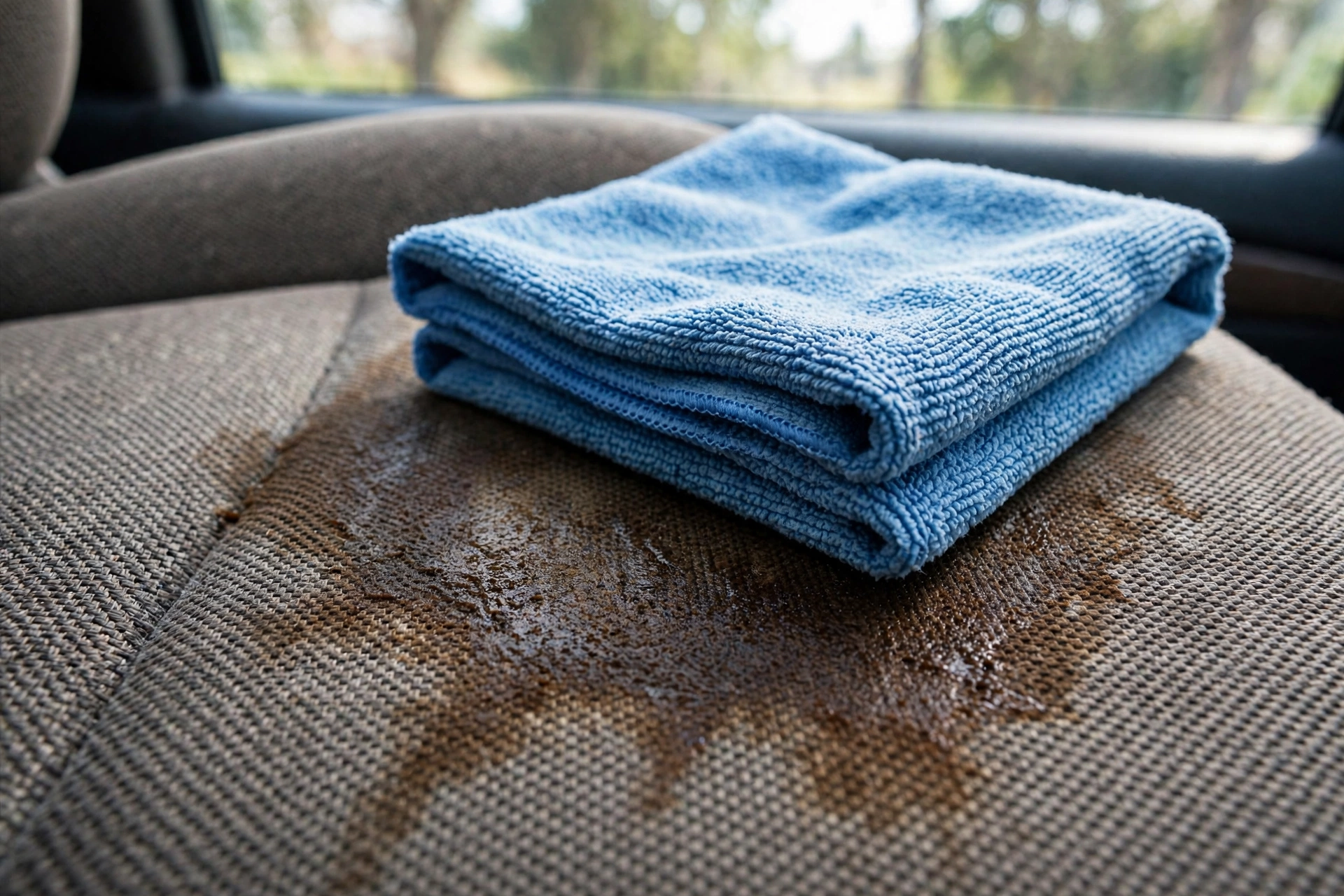
Step 2 — Apply the cleaner for the stain. Use the table below to pick the fix for your exact stain. Mist the solution onto a microfiber cloth — or lightly onto the stain itself — never pour it on.
Step 3 — Work it in, then blot it out. For fabric, a soft-bristle brush worked in small circles loosens the stain from the fibres; for the final pass, switch to blotting with a clean microfiber cloth, pressing and lifting until the cloth comes away clean. Repeat the apply-and-blot cycle rather than adding more liquid at once.
Step 4 — Dry it properly. Press an old towel into the spot to absorb as much moisture as you can, then leave the car windows open and let the seat air-dry completely — at least 2–4 hours. A damp seat that gets closed up grows mildew in the foam, and that smell is far harder to remove than the stain was.
Stain-by-stain: what to use and how long to wait
| Stain | Solution | Dwell time |
|---|---|---|
| Coffee | 1:1 white vinegar + water, then baking soda paste for stickiness | 10 minutes |
| Food (ketchup, chocolate, sauce) | 1 tsp dish soap in 1 cup warm water | 5–10 minutes |
| Grease / oil | Baking soda or cornstarch to absorb, then dish soap | 15–30 min powder, 10 min soap |
| Ink (ballpoint) | 70% isopropyl alcohol on a cotton swab, dab only | 2–3 minutes |
| Pet hair | Rubber squeegee or damp rubber glove, drag one way, vacuum | None — mechanical |
The coffee fix comes from the same vinegar-water 1:1 ratio detailers use for drink spills, followed by a baking soda paste for any lingering stickiness. For ink, dab the alcohol on with a cotton swab and test first — it can fade some dyes, so never flood the area. For grease, the powder step matters more than the soap: baking soda or cornstarch pulls the oil out of the fibres for 15–30 minutes before any liquid touches the stain, exactly like the grease-stain method for clothes.
How Do You Remove Pet Hair from Car Seats?
Vacuuming alone fails on pet hair because the hairs work themselves into fabric fibres and cling with static. The fix detailers actually use is friction, not suction: a cheap rubber squeegee — the kind that costs about $3 — dragged slowly across the seat in one direction. The rubber grabs the hair and rolls it into a line you can lift off by hand. A damp rubber glove does the same job: put it on, wipe the seat in long strokes, and the hair balls up on the glove.
Work in sections and vacuum each section right after you roll it, before the hair resettles. Do the seats first, then the carpet and the seams, where hair collects in the stitching. If the car carries a dog regularly, keep a squeegee in the trunk — five minutes after every trip beats an hour of deep cleaning once a month, and it keeps hair out of the seat foam where it eventually starts to smell.
How Do You Clean Leather and Vinyl Car Seats Differently?
Leather and vinyl look similar but fail in opposite ways, so they need different care. Leather dries out and cracks when its oils are stripped; vinyl clouds and stiffens when harsh solvents attack its coating.
Leather: use a dedicated, pH-balanced leather cleaner applied to a microfiber cloth, never sprayed directly on the seat. Wipe gently, then — and this is the step people skip — apply a leather conditioner while the seat is dry. FamilyHandyman quotes detailers on this directly: a mix of mild dish soap and warm water works in a pinch on leather, but you must condition afterward, or the leather dries out. Never use vinegar, Windex, bleach or ammonia on leather, and avoid steam on leather — heat and moisture around perforations and seams is a poor tradeoff, and it strips the oils that keep leather supple. For dye transfer from jeans, a leather cleaner on a soft cloth, applied patiently, lifts most of it; aggressive scrubbing just spreads the dye.
Vinyl (and synthetic leather): mild soap and water on a damp, non-abrasive cloth is enough. Wipe, then dry with a clean towel. Avoid alcohol-based wipes and silicone sprays — alcohol dries vinyl out, and silicone leaves a greasy film that attracts dust and turns the dash and seats shiny in the worst way. A soft-bristle brush is safe on vinyl for stuck-on grime, but keep the pressure light.
What Should You Never Do to a Car Seat Stain?
- Soak the seat. Whatever liquid you pour in cannot be rinsed out — it sinks into the foam, and damp foam grows mildew. Mist the cloth, not the seat.
- Use hot water on blood or milk. Heat sets protein stains permanently. Cold water and an enzyme cleaner only, never hot.
- Use bleach or ammonia. Both strip dye from fabric, dry out leather, and leave a chemical smell that lingers for weeks.
- Use vinegar on leather. Vinegar strips the natural oils from leather and can cause drying and discolouration. Save vinegar for fabric and glass.
- Scrub in hard circles. On fabric it spreads the stain and frays the fibres; on leather it scratches. Small, gentle passes — or blot and lift.
- Skip the spot test. Ten minutes on a hidden seam is the difference between a clean seat and a faded patch. Every cleaner, every time.
What If the Stain Won’t Come Out?
If two full apply-and-blot cycles leave a visible shadow, the stain has reached the foam — and no amount of surface cleaning will reach it. The next step is a portable carpet extractor (rented, with an upholstery attachment): it sprays cleaning solution in and vacuums it straight back out, which is the only DIY way to rinse a seat properly. FamilyHandyman’s detailers say the same thing — they would always prefer to steam, shampoo and extract for a deep clean, and home methods solve the stain or at least reduce it before that step.
If the extractor does not lift it either, a professional detailer is the honest answer: they have hot-water extraction and enzyme treatments that are not sold retail. And if the stain is truly set — years-old coffee, ink baked in by summer heat — a fitted seat cover costs less than a reupholster and hides the problem completely.
Frequently Asked Questions
Sources: FamilyHandyman — “How to Get Stains Out of Car Seats” (material-specific cleaners, spot-test rule, detailer quotes on steam/shampoo/extraction). Upholstery cleaning codes W/S/WS/X — standard industry system for matching cleaner to fabric (water-based / solvent-only / either / vacuum-only).
Related: 10 Genius Dollar Tree Car Hacks to Organize Your Car Under $10 | How to Clean Carpet Stains | How to Remove Any Stain: A Step-by-Step Guide by Surface & Stain Type | How to Remove Coffee Stains from Clothes | How to Remove Grease Stains from Clothes