How to Clean the Inside of Your Windshield (Streak-Free, No Haze)
Your windshield looks clean in the driveway — then night driving turns it into a foggy mess. Every oncoming headlight blooms into a starburst, and no amount of wiping seems to fix it. The problem is not dirt. Learning how to clean inside of windshield glass the right way starts with understanding what that haze actually is, because the wrong cleaner just smears it around.
The haze on the inside of your windshield is an oily film from your dashboard vinyl off-gassing, not dirt — so plain glass cleaner smears it instead of removing it. Degrease first with rubbing alcohol (50/50 with water), then wipe with an ammonia-free glass cleaner on a microfiber cloth, and buff dry immediately with a second dry cloth. Work in straight lines, never circles, and never use ammonia near tinted windows.
Why Is the Inside of Your Windshield Always Hazy?
That stubborn film is plasticizer — oily chemicals slowly released by your dashboard vinyl and trim as they heat up in the sun, a process called off-gassing. The vapour condenses on the coolest surface in the car: the inside of the glass. It builds up invisibly over weeks, which is why the windshield looks fine in daylight and terrible at night, when headlights scatter through the film. This is why regular glass cleaner fails. Most household glass cleaners are made for dust and fingerprints, not an oil film. Spraying one on the haze just moves the oil around in thinner streaks. You have to break the oil down first — that is the whole trick, and it is also why the two-towel method below works where a single wipe does not.
What Do You Need to Clean the Inside of Your Windshield?
You need very little, and you probably own most of it already. Two clean microfiber cloths matter more than any product — one for cleaning, one kept completely dry for buffing.
- Two lint-free microfiber cloths (flat-weave glass towels are best; avoid cotton towels and paper towels — both leave lint that shows up in sunlight)
- Rubbing alcohol (isopropyl) mixed 50/50 with water in a spray bottle, for the degrease step
- An ammonia-free glass cleaner, or the homemade mix below
- A long-handled window wand (optional, but the only comfortable way to reach the bottom edge where the glass meets the dashboard)
| Cleaner | Mix | Best for | Watch out |
|---|---|---|---|
| Rubbing alcohol 50/50 | 1 part isopropyl alcohol, 1 part water | Breaking down the oily off-gas film | Use for the first pass only, not as the final wipe |
| AAA homemade glass cleaner | 3 parts water, 1 part white vinegar, a few drops of dish soap | Everyday cleaning after the degrease step | Never on tint if it contains ammonia — this mix has none, so it is tint-safe |
| Iowa State Extension mix | 50% white vinegar, 50% water | Light haze and smoke film | Strong vinegar smell while wet; it fades as it dries |
| Store-bought auto glass cleaner | Ready to use | Fastest option | Must say ammonia-free — ammonia breaks down window tint film over time |
The AAA recipe (3 parts water to 1 part vinegar plus a few drops of dish soap) and the Iowa State University Extension 50/50 vinegar-water mix are both published, named sources — not anonymous “DIY hacks.” Use either for the cleaning pass after degreasing.
How Do You Clean Inside of Windshield Glass Without Streaks?
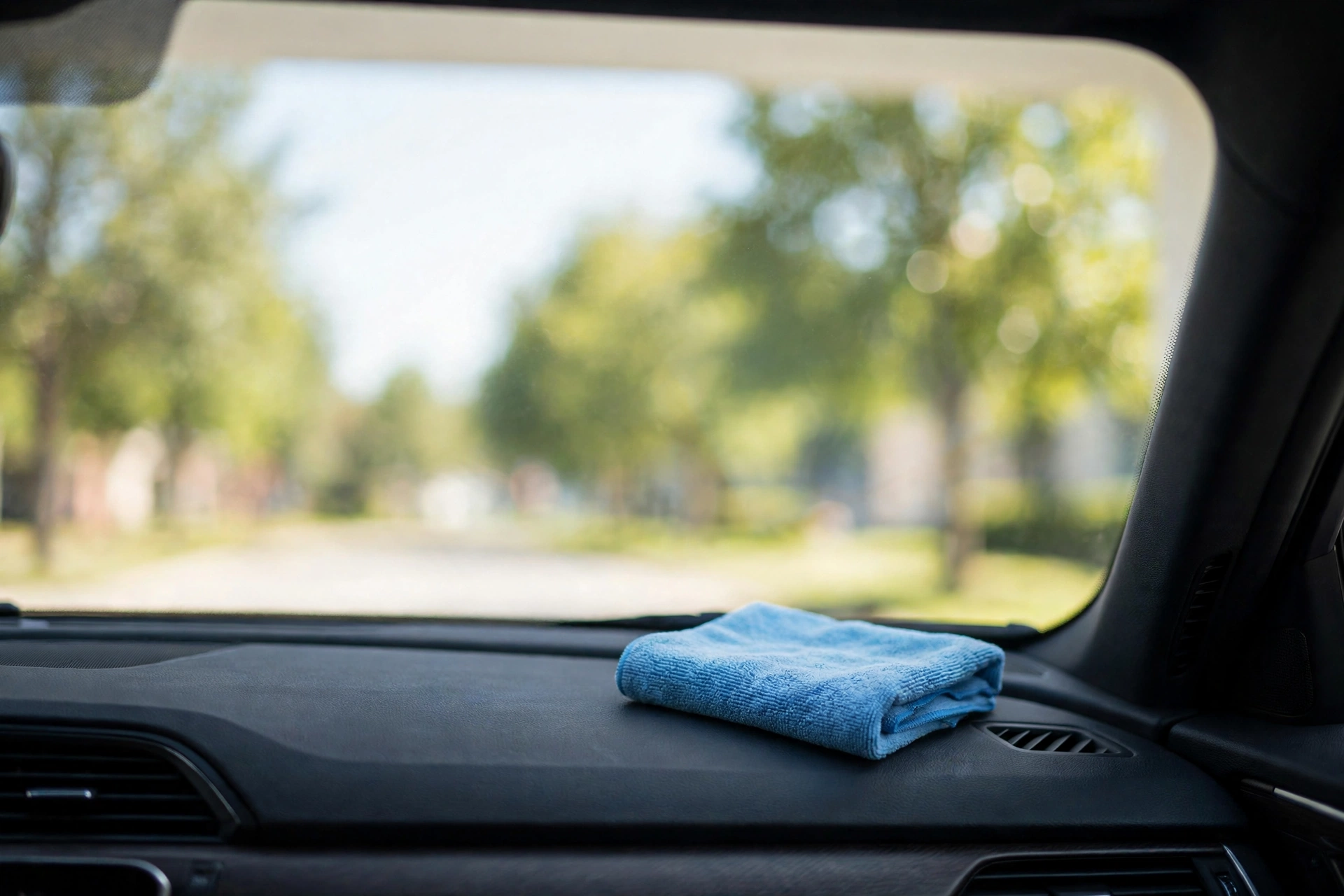
Work in the shade or a garage. A hot windshield dries cleaner before it can work, and that is how streaks are born. Clean the glass last — after seats, carpets and dashboard — so overspray from other products does not land on glass you already cleaned.
Step 1 — Degrease. Mist the rubbing-alcohol mix onto one microfiber cloth, never directly onto the glass. Wipe the whole windshield in straight, overlapping horizontal strokes. This pass breaks the oil film down; the cloth will pick up a faint grey-yellow residue. That residue is the haze leaving the glass.
Step 2 — Clean. Fold the second cloth into quarters so you always have a fresh face. Mist your glass cleaner (or the AAA/Iowa State mix) onto the cloth and wipe the glass again in straight strokes, working in sections about two square feet at a time. Pay extra attention to the lower corners near the dashboard and the top edge near the headliner — both trap more off-gassed film than the centre.
Step 3 — Buff dry immediately. Before the cleaner can evaporate, buff the section with a completely dry microfiber cloth using vertical strokes. The direction change is the point: horizontal for cleaning, vertical for buffing. Any streak left behind will run in one clear direction, so you can see it and catch it before you are done.
Reaching the bottom edge. Sit in the passenger seat and lean across the centre console toward the driver’s side. The angle gives you real pressure at the glass-dashboard junction, where film is thickest and arms are shortest. A long-handled window wand does the same job without the stretch.
Final check. Hold a flashlight at a low angle against the glass, or look at it against sunlight. Streaks that are invisible straight-on show up immediately at an angle. Re-buff any spot that shows a trail — and re-buff with the dry cloth, not more cleaner.
How Do You Tell If a Streak Is Inside or Outside?
Wipe the outside of the windshield in one direction (say, horizontal) and the inside in the opposite direction (vertical). Then look at any streak that remains: a horizontal streak is on the outside, a vertical streak is on the inside. It is a five-second diagnostic that saves you from cleaning the wrong side of the glass twice — and it is the same trick professional detailers use, because the streak direction tells you exactly where the problem lives.
What Should You Never Use on the Inside of Your Windshield?
- Ammonia glass cleaner near tint. Ammonia breaks down the dye layer and adhesive in window tint film over time, and it can dry out and crack the vinyl dashboard around the glass. If your windows are tinted, the cleaner must say ammonia-free on the label.
- Paper towels. They break down when wet and leave paper dust and lint that reads as specks in sunlight. Microfiber only.
- Circular motions. Circles redistribute the oily film instead of removing it. Straight, overlapping strokes — horizontal to clean, vertical to buff.
- Spraying cleaner on the glass. Overspray lands on the dashboard, in the vents and on electronics. Spray the cloth, never the glass.
- Cleaning in direct sun. Heat evaporates the cleaner before it lifts the film, which is the most common cause of fresh streaks right after cleaning.
How Often Should You Clean the Inside of Your Windshield?
Every one to two months in normal use, or whenever night glare starts to bloom. Cars parked in the sun build film faster, because heat speeds up the dashboard off-gassing — a car that bakes in a sunny lot can haze up in weeks. A sunshade on the dashboard slows it down noticeably, since it keeps the vinyl cooler. If you smoke in the car, clean monthly: nicotine adds a yellow-brown film on top of the plasticizer haze, and it needs the same degrease-first method, just with a second degrease pass.
What If the Haze Won’t Come Off?
If two full degrease-and-buff passes still leave a film, the problem is usually deeper than surface haze. Smoke film, years of built-up residue, or a failing cabin air filter can keep re-coating the glass from the inside — the filter sits in the airflow path, and a saturated one blows stale, oily air straight at the windshield. Replace the cabin air filter (it is a five-minute job on most cars, behind the glove box), then repeat the 3-step clean once. If the haze returns within days after a new filter, the film is coming from a vinyl protectant or dressing overspray on the dashboard — stop using it, wipe the dash with a damp microfiber cloth, and clean the glass again.
Why does the inside of my windshield get hazy?
The haze is an oily film from your dashboard vinyl releasing chemicals (plasticizers) as it heats up — a process called off-gassing. The vapour condenses on the inside of the glass. It is not dirt, which is why ordinary glass cleaner smears it instead of removing it.
Can I use vinegar to clean the inside of my windshield?
Yes. The Iowa State University Extension recommends a 50/50 mix of white vinegar and water for car interiors, and AAA’s recipe is 3 parts water to 1 part vinegar with a few drops of dish soap. Both are tint-safe because they contain no ammonia — but degrease with rubbing alcohol first if the haze is heavy.
Can I use Windex on the inside of my windshield?
Only if it is the ammonia-free version. Standard ammonia glass cleaners damage window tint film over time and can dry out the vinyl dashboard. Check the label: if it does not say ammonia-free, do not use it on interior glass.
Why do streaks show up at night but not during the day?
At night, oncoming headlights shine through the oily film at a low angle, and the light scatters — that is the starburst and glare you see. In daylight the light comes from above and the film is nearly invisible. A flashlight held at a low angle against the glass shows the same streaks in the daytime.
Sources: AAA (homemade glass cleaner recipe: 3 parts water, 1 part vinegar, a few drops of dish soap) · Iowa State University Extension (50/50 vinegar-water mix for car interiors).
Related: 10 Genius Dollar Tree Car Hacks to Organize Your Car Under $10 · How to Clean Carpet Stains · How to Remove Any Stain: A Step-by-Step Guide by Surface & Stain Type · How to Remove Grease Stains from Clothes · How to Remove Pet Urine Smell: From Carpet, Floors, and Furniture