NFPA 70E Arc Flash Label Requirements Explained
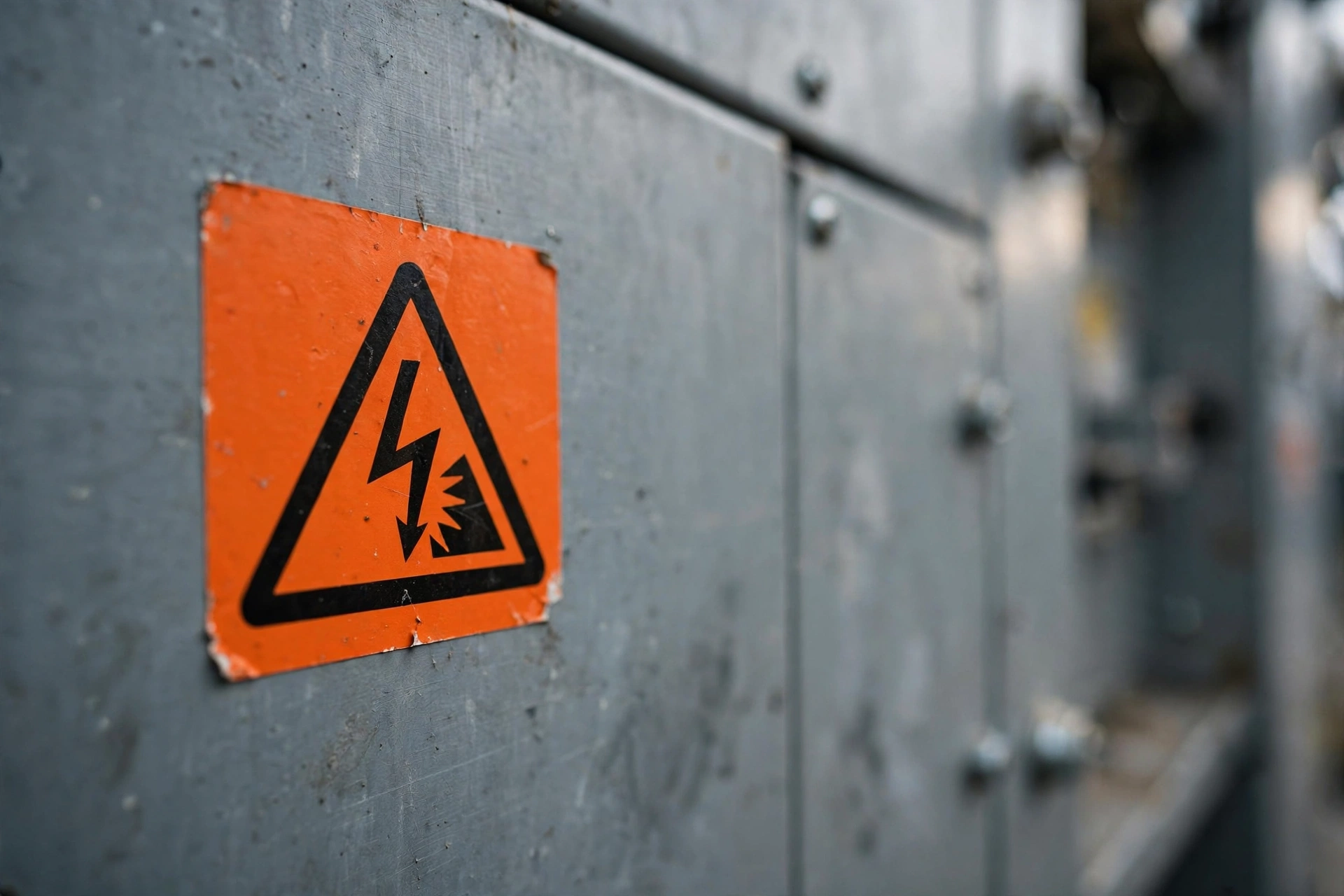
That orange warning sticker on an electrical panel isn’t decoration — it’s an arc flash label, and NFPA 70E requires it. Here’s what the standard demands, what each field means, and how to read the label before you touch anything.
Why Arc Flash Labels Exist
Arc flash labels exist because an arc flash can release lethal energy in a fraction of a second, and workers need to know the danger before opening a panel. The label states the hazard level and required PPE for that specific equipment, so no one has to guess — the safety information is posted right where the work happens.
The label answers that. NFPA 70E requires equipment labels so that no one has to guess — the hazard information is posted right where the work happens.
Where Labels Are Required
NFPA 70E requires arc flash labels on electrical equipment that is likely to require examination, adjustment, servicing, or maintenance while energized. The rule targets any equipment a qualified worker might open or work on while live, because that is when arc flash exposure is foreseeable and the label’s warning is needed most.
- Switchboards and panelboards
- Motor control centers (MCCs)
- Industrial control panels
- Meter socket enclosures
- Any equipment where an arc flash hazard exists and interaction is foreseeable
If qualified workers might open it while it’s live, it should be labeled.
What Must Be on the Label
NFPA 70E requires every arc flash label to include, at minimum, the nominal system voltage, the arc flash boundary, and at least one of the following: the available incident energy at the working distance, the minimum arc rating of clothing, or the required PPE category. Together these fields tell workers the hazard and the protection needed.
- Nominal system voltage — the equipment’s voltage level.
- Arc flash boundary — the distance within which arc flash PPE is required. Cross this line without proper PPE and you’re in the danger zone.
- At least one of the following: Available incident energy (cal/cm²) at the working distance, plus the working distance itself — or minimum arc rating of clothing required — or required PPE category (CAT 1–4) — or site-specific PPE level.
Most modern labels show the incident energy number and the corresponding PPE category, so workers can match it directly to their gear.
How to Read an Arc Flash Label (Step by Step)
Say you’re standing in front of a labeled panel. Read it like this:
- Check the voltage — confirms you’re looking at the right equipment and the right hazard class.
- Note the arc flash boundary — stay outside it unless you’re wearing the listed PPE.
- Read the incident energy (cal/cm²) — this is the heat energy you’d face at the working distance. Higher number = more dangerous.
- Match your PPE — your clothing’s arc rating must be at or above the incident energy. If the label says 8 cal/cm² and your shirt is rated 8 cal/cm² (CAT 2), you’re covered. If your gear is rated lower, stop and get the right PPE.
- Check the date/study reference — labels are based on an arc flash study. If the equipment changed since the study, the label may be outdated — report it.
What “Site-Specific PPE Level” Means
Some facilities skip the CAT numbers and list their own PPE levels (e.g., “Level 2 PPE required”). This is allowed — the label just has to communicate clearly what protection is needed. If your site uses custom levels, make sure you know what each one requires before you need it.
Common Label Problems to Watch For
- Missing labels — older installations often predate labeling requirements. No label doesn’t mean no hazard.
- Outdated labels — equipment upgrades, breaker changes, or utility modifications can invalidate the study behind the label.
- Damaged/unreadable labels — heat, chemicals, and UV fade labels. If you can’t read it, treat the equipment as unlabeled and report it.
- Generic labels — a label that just says “Arc Flash Hazard” with no data doesn’t meet the requirement. The numbers matter.
Labels vs Your FR Clothing
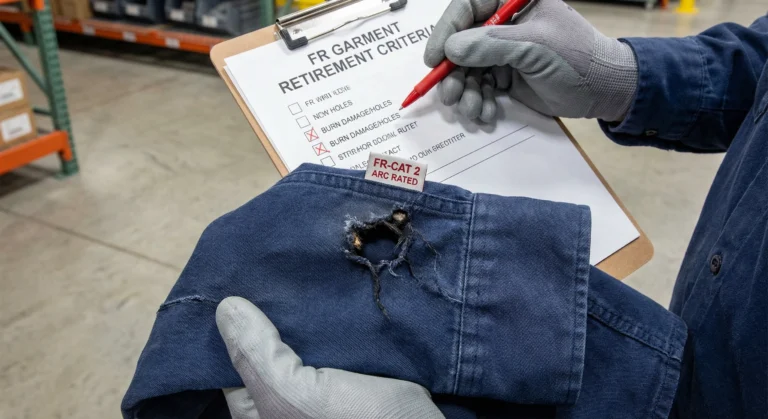
The label tells you the hazard; your clothing provides the protection. The two connect through one rule: your PPE’s arc rating must meet or exceed the label’s incident energy.
That’s why understanding CAT levels matters — and why knowing what FR clothing is is the foundation. The label, the study, and your gear are three parts of one system.
Who performs the arc flash study behind the label?
A qualified electrical engineer or a trained arc flash study provider typically performs the study behind the label. They model the electrical system, calculate incident energy and the arc flash boundary, and document the results. The employer then uses those results to produce and install the labels on each piece of equipment.
What is the difference between an arc flash label and a shock hazard label?
An arc flash label warns about thermal burn energy from an arc blast, listing incident energy, the arc flash boundary, and required PPE. A shock hazard label warns about electric shock, listing voltage and the shock approach boundaries. Many panels carry both labels because the two hazards are different, and each requires its own protection.
FAQs
Are arc flash labels required by OSHA or NFPA 70E?
NFPA 70E specifically requires arc flash labels on electrical equipment. OSHA enforces electrical safety generally, and its inspectors treat 70E-compliant labeling as the recognized practice for meeting those duties. In short, NFPA 70E sets the labeling rule, while OSHA provides the legal enforcement behind it.
Who is responsible for putting labels on equipment?
The employer or facility owner is responsible for arc flash labels. Labels come out of the arc flash risk assessment, which the employer commissions and maintains — they are not something the equipment manufacturer provides by default. Keeping labels current after system changes is also the employer’s duty.
How often do labels need updating?
Labels must be updated whenever the electrical system changes in a way that affects the arc flash study — new equipment, different breakers, or utility changes. NFPA 70E also calls for periodic review of the risk assessment, typically every five years, so outdated labels are caught even without a system change.
What if there’s no label on a panel I need to open?
Stop. Treat it as an unknown hazard: don’t work on it energized until it’s been assessed and labeled. Report it to your supervisor — unlabeled equipment is a program gap, not your problem to solve alone.
Related Reading
- OSHA vs NFPA 70E
- What Is FR Clothing?
- NFPA 2112 Explained